


The CD-2XS2 is a cylindrical light diffuser with an outer diameter of ~450 µm for interstitial illumination of small target volumes up to ~10 mm in diameter in preclinical PDT, photobiology and optogenetics research.
To our knowledge, it is the thinnest cylindrical light diffuser commercially available.
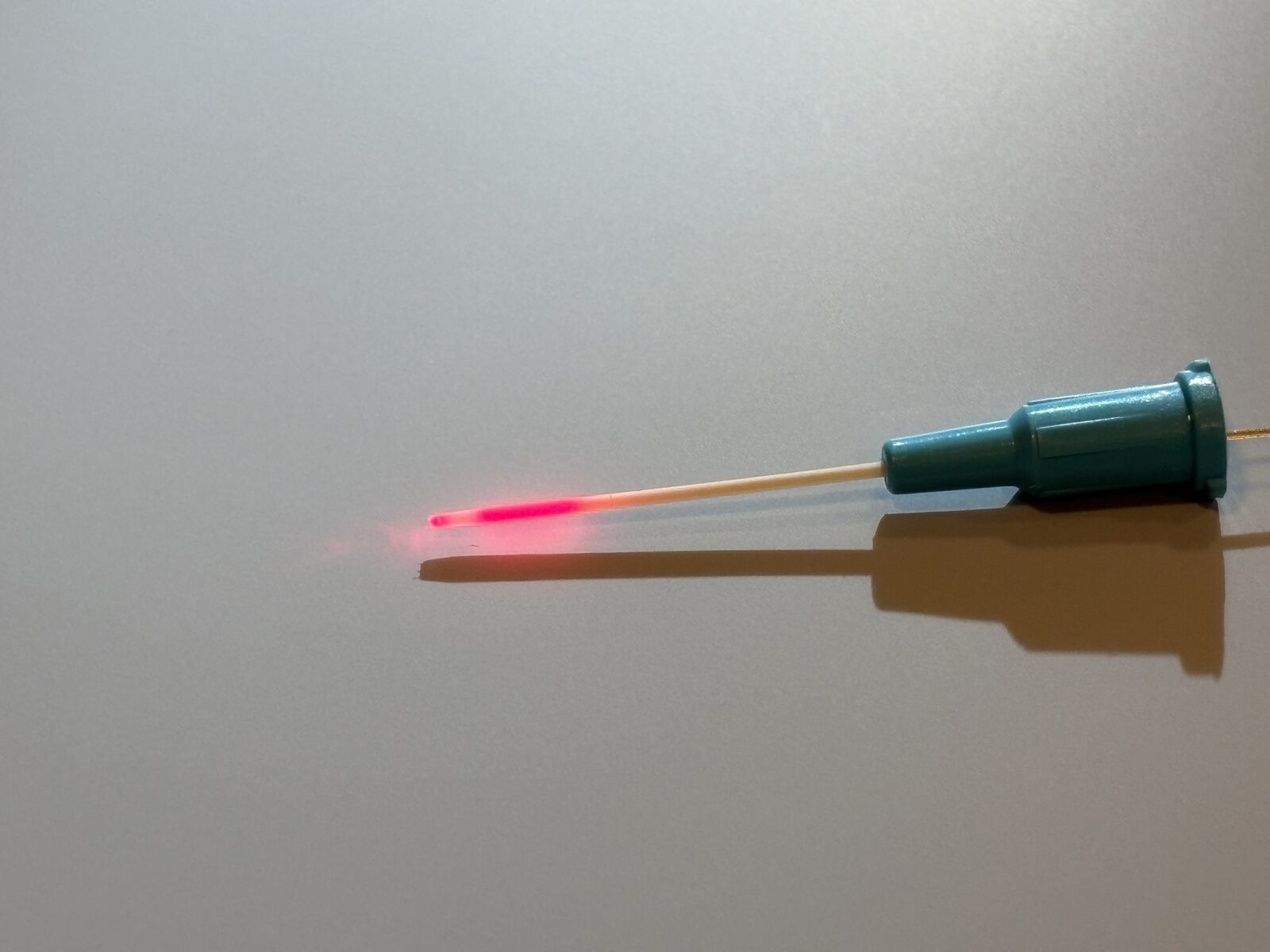
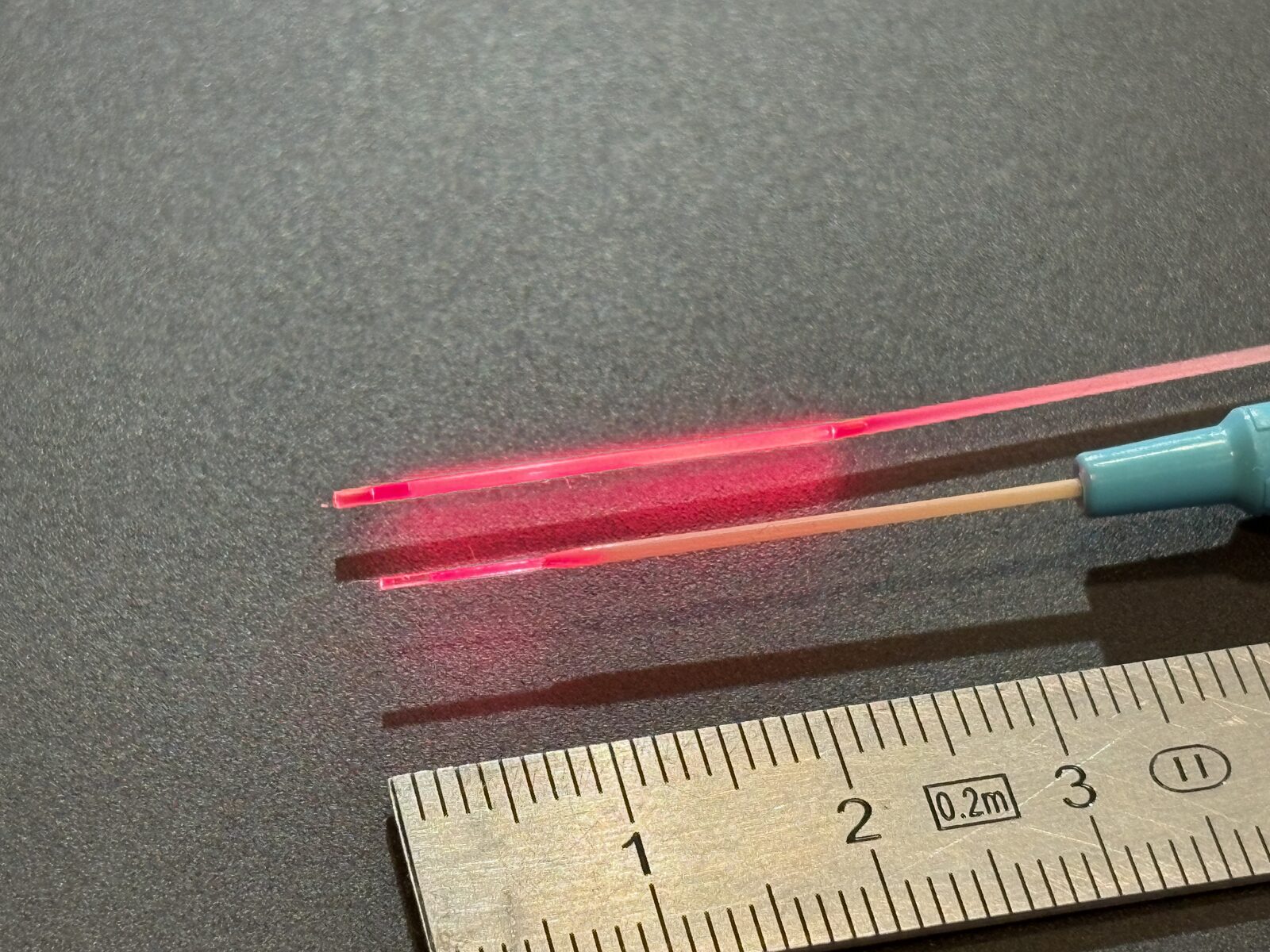
A bare fiber with a flat tip illuminates only a small cone in front of it and concentrates the optical power at one point. The CD-2XS2 emits light radially and uniformly along its 5 or 10 mm diffusing tip. The same optical power is spread over the whole target length – without a hot spot at the tip.
This reduces local tissue heating, which is often the limiting factor in optogenetic and photobiological experiments, and makes the light dose in the target volume easier to define.
| Model | Diffusing tip | Typical target |
|---|---|---|
| CD-2XS2-05 | 5 mm | targets up to 5–7 mm |
| CD-2XS2-10 | 10 mm | targets up to 10 mm |
| Outer diameter | ~450 µm |
|---|---|
| Insertion | fits through a 22G cannula (OD ~840 µm) |
| Diffusing tip | 5 mm (-05) or 10 mm (-10) |
| Fiber length | 2.0 m · longer versions on request |
| Emission | radial, uniform along the diffusing tip |
| Standard wavelengths | 400–455 nm · 630–810 nm · ~860 nm |
| Other wavelengths | on request, e.g. 470 / 530 / 590 nm |
| Core diameter | 200 µm |
| Numerical aperture | 0.22 |
| Typical transmission | > 75 % |
| Uniformity | ± 20 % along the diffusing tip |
| Max. power density | 200 mW/cm |
| Connector | SMA 905 |
| MR compatibility | fiber and diffuser MR-compatible; the laser-side connector stays outside the magnet |
| X-ray marker | none |
| Regulatory status | research use only, not CE marked |
Standard wavelength ranges are 400–455 nm, 630–810 nm (including far-red) and ~860 nm. This covers blue-light optogenetic actuators and photoswitches, the red and NIR photosensitizers used in PDT and photoimmunotherapy, and nanoparticle-mediated photothermal therapy. Other wavelengths are available on request – please contact us.
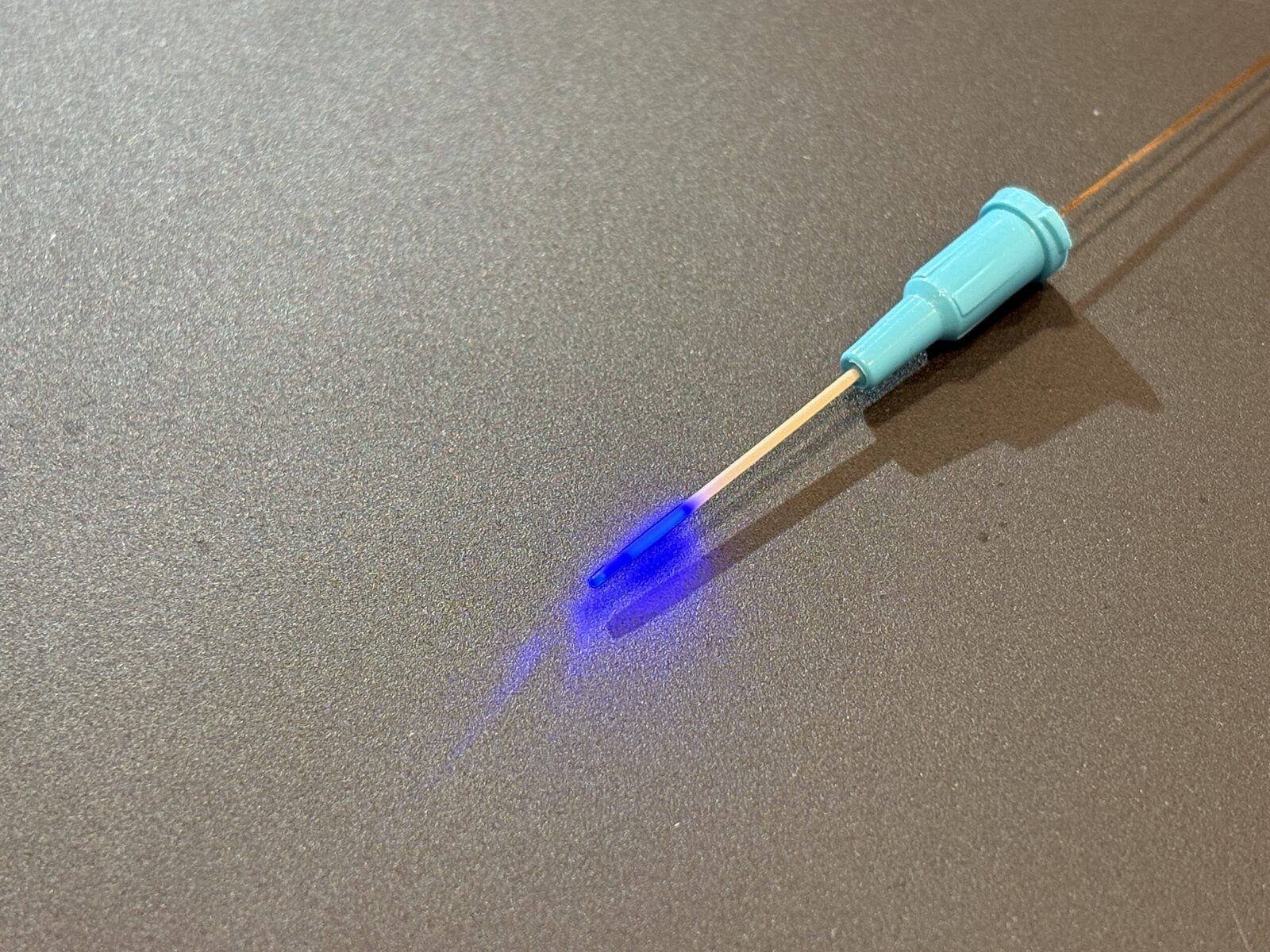
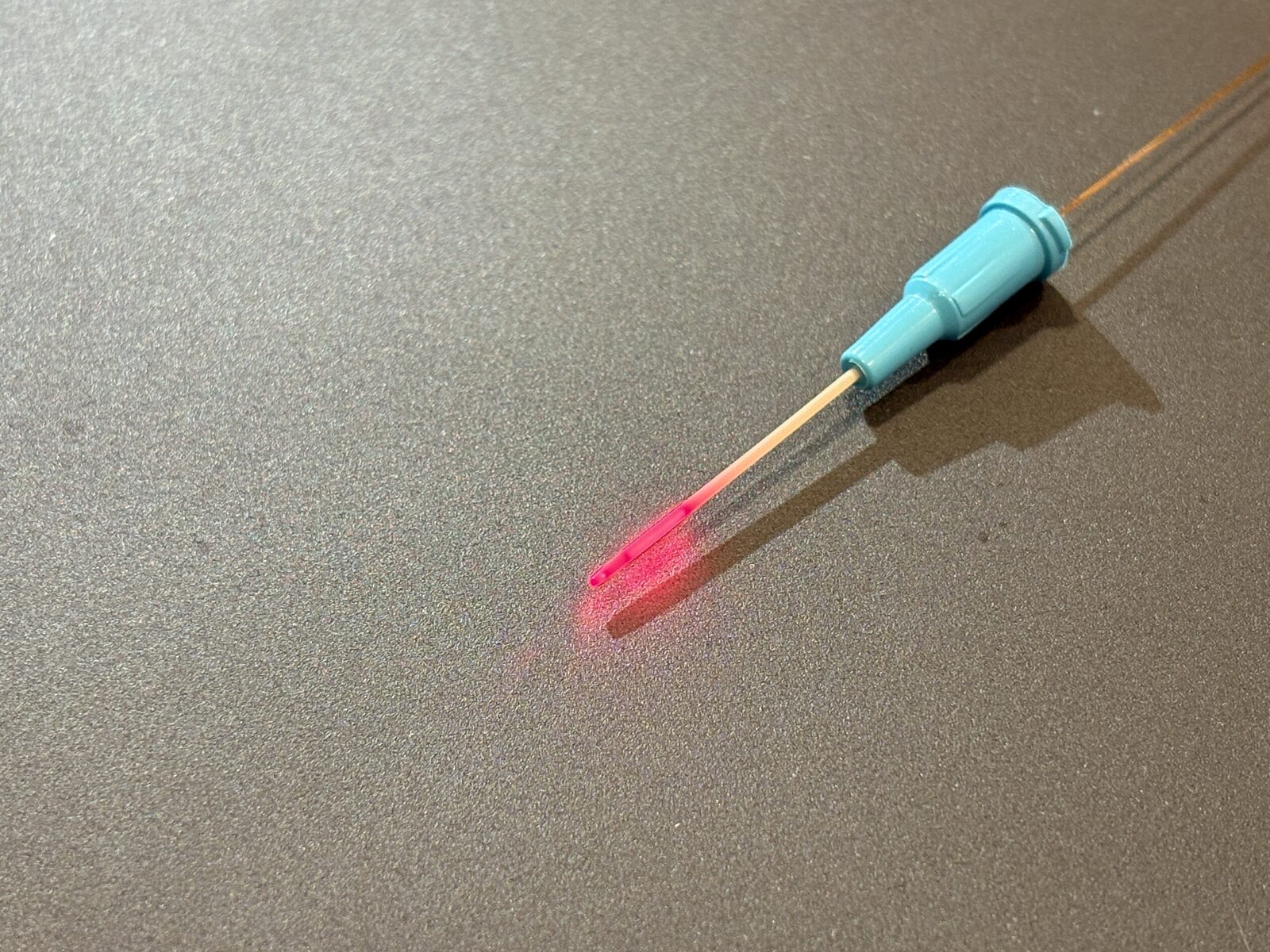
CD-2XS2-05 at 450 nm and 660 nm
| Application | Benefit of the CD-2XS2 | Typical wavelength |
|---|---|---|
| Interstitial PDT of small tumors | uniform dose in small target volumes | 630–810 nm |
| NIR photoimmunotherapy (PIT) | interstitial illumination of the whole target with cylindrical light | ~690 nm |
| Photothermal therapy and light-triggered drug release with nanoparticles | interstitial NIR light instead of external illumination – reaches the full target depth | 808–860 nm |
| Cardiac optogenetics (pacing, defibrillation research) | simultaneous illumination of a larger tissue area instead of a point | blue / red |
| Peripheral and intestinal optogenetics | matches the cylindrical geometry of hollow organs and nerves | blue / red |
| Light-controlled gene expression, designer cells | homogeneous illumination of a tissue volume or cell depot | blue, red, far-red (~740 nm) |
| In vivo photoconversion / photolabeling of cells in hollow organs | uniform violet light along the organ wall | ~405 nm |
| Photobiomodulation research | light delivery into a volume | ~670 nm, 810 nm |
| Interstitial spectroscopy and dosimetry | defined cylindrical reference source | broadband |
| In situ illumination NMR (photochemistry, photoredox catalysis) | illuminates the full active coil volume in the NMR tube, not only the fiber tip; fits a coaxial insert in a 5 mm tube | 400–455 nm, 630–810 nm; others on request |
| Light-induced hyperpolarization (photo-CIDNP) for NMR and MRI | uniform light delivery inside the magnet; laser stays outside the stray field | 400–455 nm; others on request |
| MRI-monitored light delivery (e.g. MR thermometry, optogenetic fMRI) | MR-compatible light applicator | depending on application |
LifePhotonic supplied the light-guiding fiber technology for the BMBF joint project BioPACE – Biohybrids for Photon-Activated Cardiac Excitation (2016–2019) – on optical stimulation of heart and skeletal muscle, with Laser Zentrum Hannover (coordinator), Medizinische Hochschule Hannover, CAN GmbH and Universitätsklinikum Bonn. Press release (LZH)
The CD-2XS2-05 (5 mm diffusing tip) and CD-2XS2-10 (10 mm) are designed for target volumes up to ~10 mm in diameter.
Yes. With an outer diameter of ~450 µm the CD-2XS2 fits through a standard 22G cannula (OD ~840 µm).
Yes, for acute illumination of tissue volumes, e.g. in cardiac, peripheral or intestinal optogenetics. Standard wavelengths cover blue (400–455 nm) and red to far-red (630–810 nm); other wavelengths are available on request. The CD-2XS2 is not designed for chronic implantation.
Standard: 400–455 nm, 630–810 nm and ~860 nm. Other wavelengths on request – please contact us.
Yes. The fiber and diffuser are MR-compatible; only the connector at the laser is not, and it stays outside the magnet together with the laser. For NMR and MRI setups we build longer fibers, e.g. 5–10 m, on request. LifePhotonic cylindrical diffusers have already been used for light delivery during MRI thermometry (Gouges et al., Photodiagnosis and Photodynamic Therapy 2026, DOI: 10.1016/j.pdpdt.2026.105544).
With an outer diameter of ~450 µm it fits into a coaxial insert in a standard 5 mm NMR tube. The 10 mm diffusing tip (CD-2XS2-10) illuminates the sample along the active coil region; longer diffusing lengths on request.
The CD-2S3 is a CE-marked clinical diffuser with X-ray markers and 3 m length. The CD-2XS2 is thinner (~450 µm), 2 m long, has no X-ray marker and is intended for research use only.
No. The CD-2XS2 is supplied for research use only and is not CE marked. It must not be used on humans.
Please cite as: cylindrical diffuser CD-2XS2-05 (LifePhotonic GmbH, Bonn, Germany) – or CD-2XS2-10 accordingly.
Please state your wavelength(s), laser power or power density and, if possible, your application – we will reply with a quote or a suggestion for a custom version.
pdt@lipho.eu · +49 228 9339 8400
LifePhotonic GmbH · Droste-Huelshoff-Str. 3 · 53129 Bonn · Germany
Last updated: 21 October 2026