


LifePhotonic cylindrical diffusers deliver uniform light from inside a volume – a liquid culture, a biofilm model, a tube or a bioreactor – instead of from outside.
They are used in research on antimicrobial photodynamic inactivation (aPDI / aPDT), antimicrobial blue light (aBL) and light-controlled bioprocesses.
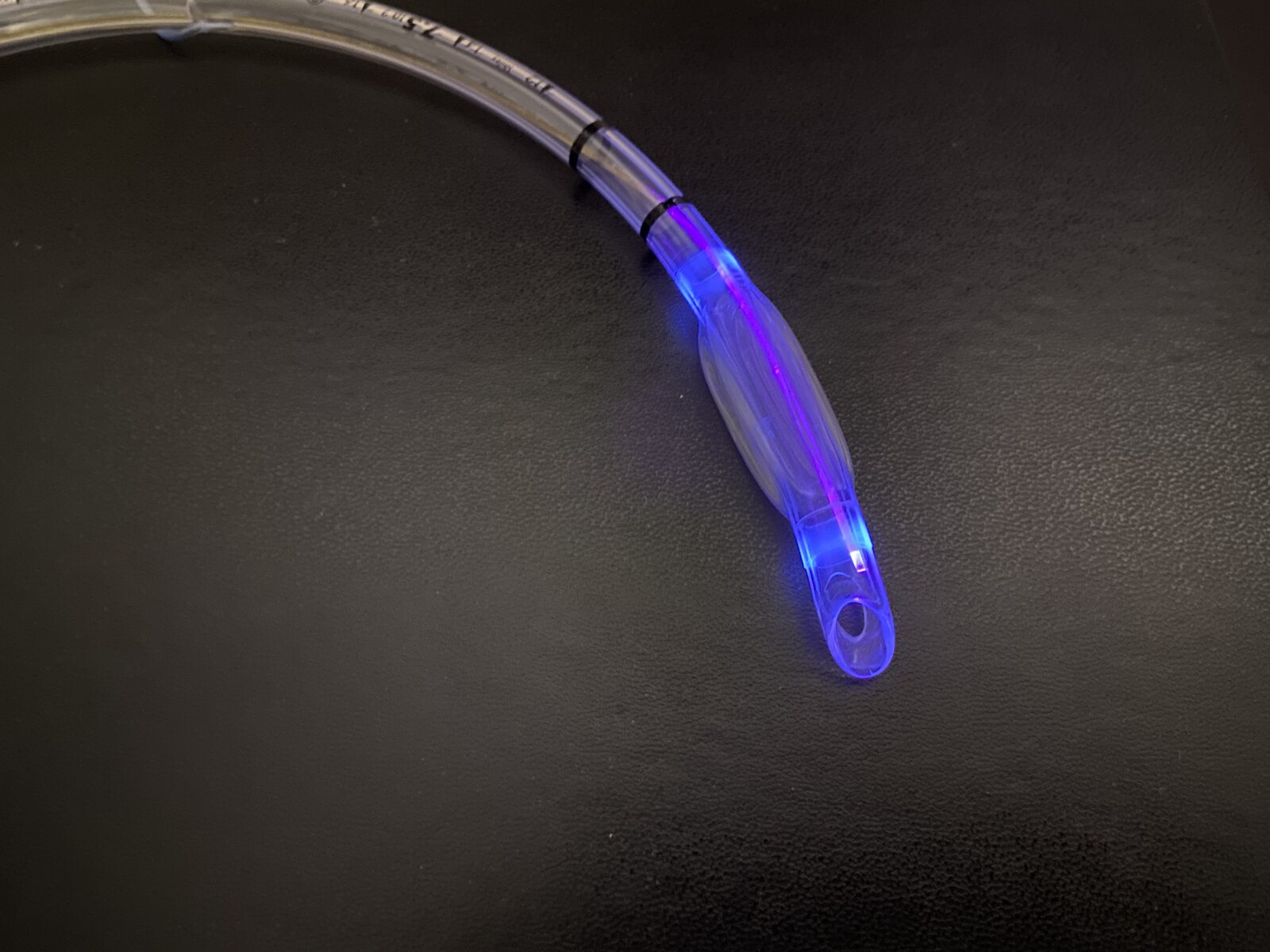
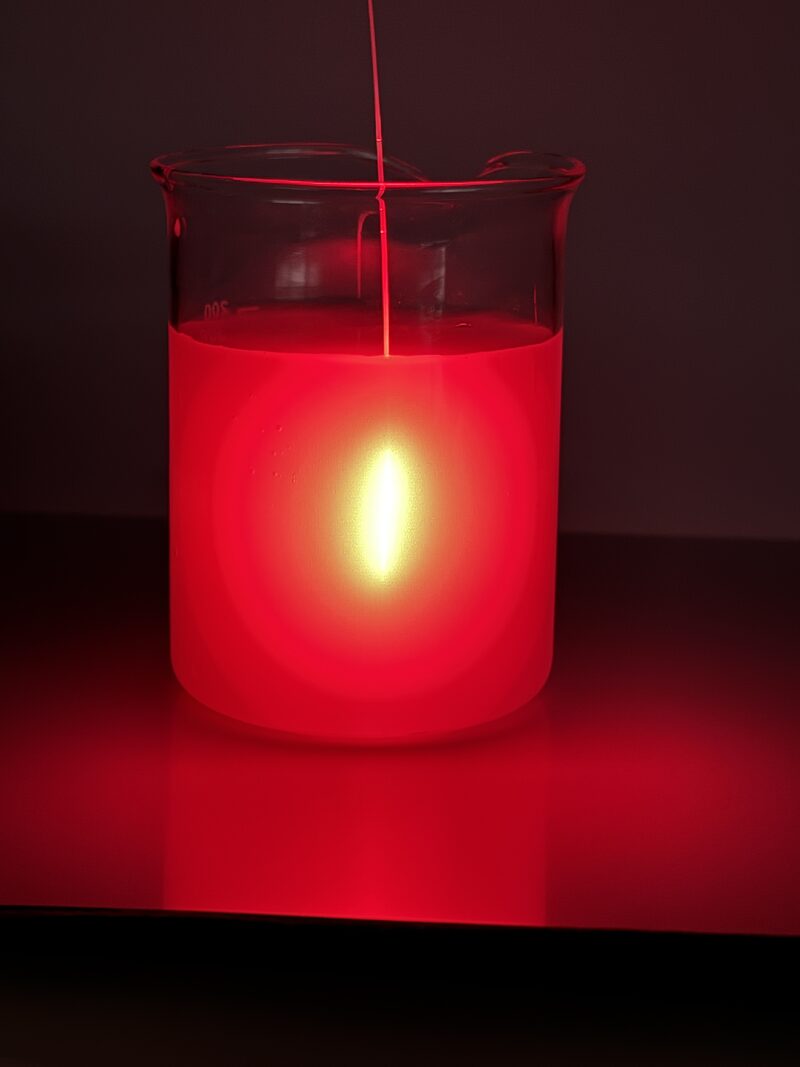
External illumination loses intensity quickly in turbid media and leaves shadowed regions – in dense cultures, inside tubes and lumens, or in larger vessels. A cylindrical diffuser placed in the volume emits light radially along its whole length.
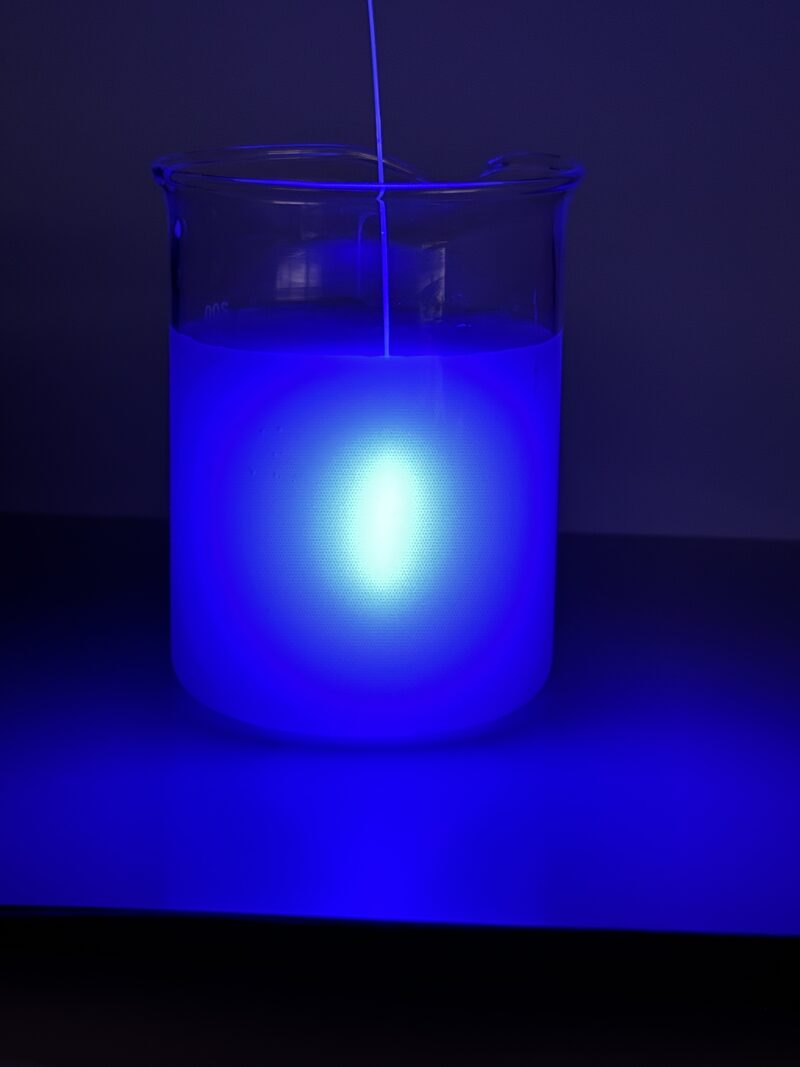
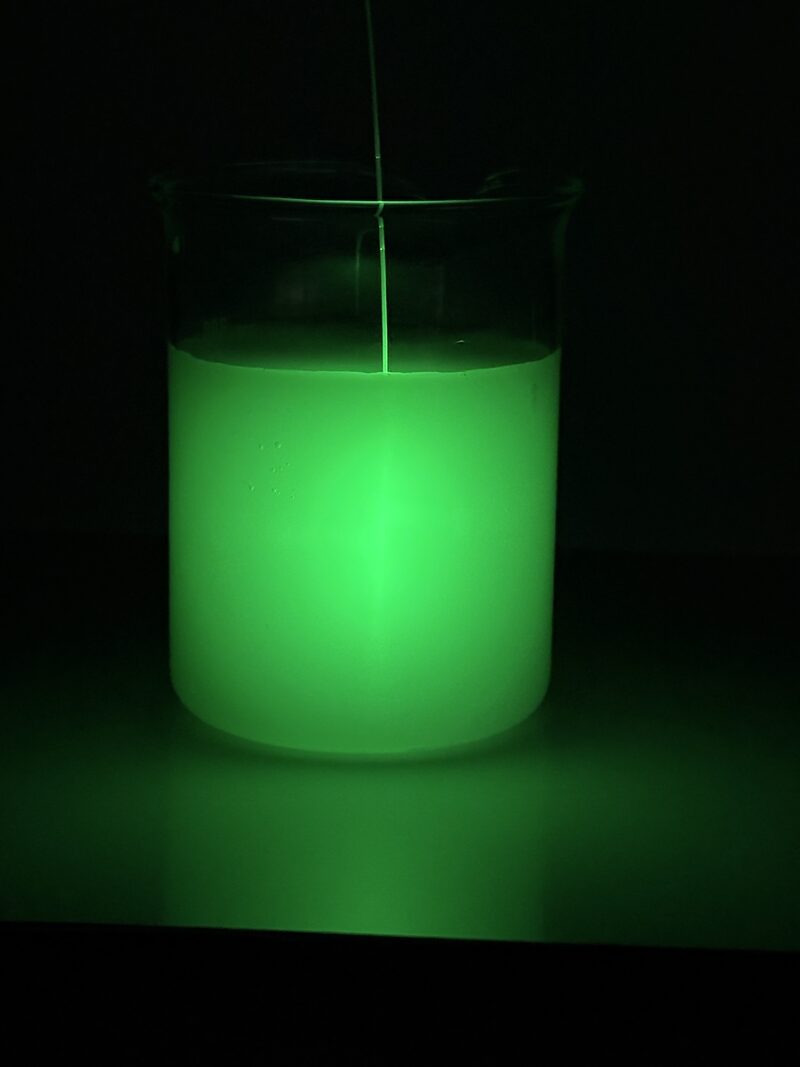
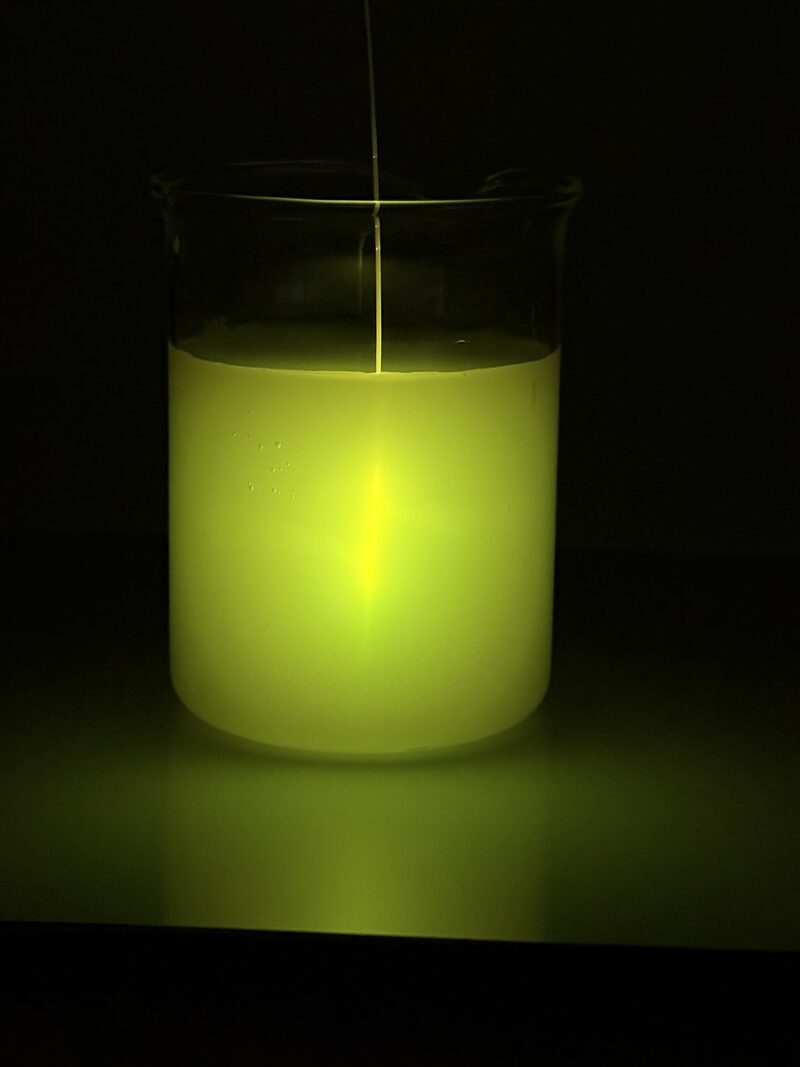
| Wavelength | Typical use in research | Absorption maxima in nm (literature) |
|---|---|---|
| 405 nm | antimicrobial violet-blue light via endogenous porphyrins; porphyrin and chlorin photosensitizers (Soret band); curcumin | endogenous porphyrins / protoporphyrin IX ~405; chlorin e6 ~400–405; chlorophyllin ~405; Photofrin ~400–405; temoporfin ~415–420; curcumin ~420–430 |
| 450 nm | antimicrobial blue light via endogenous flavins; riboflavin, FMN; blue-light optogenetics | riboflavin / FMN ~444–450; curcumin (tail) |
| 530 nm | xanthene dyes | eosin Y ~517–524; erythrosin B ~525–530; rose bengal (flank) |
| 565 nm | long-wavelength xanthene excitation; hypericin | rose bengal ~549; hypericin ~550 / 590 (main band ~590) |
| 660 nm | phenothiazinium dyes, chlorins; red-light optogenetics | methylene blue ~660–665; chlorin e6 ~660; temoporfin ~652; toluidine blue O ~630 (use 630 nm) |
| 690–810 nm | NIR-absorbing photosensitizers – deeper penetration into turbid media and tissue models | verteporfin ~690; redaporfin ~749–753; padeliporfin ~753; indocyanine green ~780–805 (solvent-dependent) |
Values for aqueous solution; peak positions shift with solvent, aggregation and binding. The diffusers work across 630–810 nm; other wavelengths on request.
| Diffuser | Typical setup |
|---|---|
| thin, flexible diffusers CD-2S3 | tubes, lumens, flow cells |
| very flexible diffusers CD-403 | narrow, curved tubing and catheters (3 Fr); transparent or milky tubing, as long as it does not absorb the wavelength |
| self-supporting diffusers CD-4L3 | beakers, culture vessels, bioreactor ports |
| long diffusing sections | larger vessels and bioreactors (on request) |
| CD-2XS2 | very small volumes, micro-scale models (5 / 10 mm) |
The BMBF-funded joint project NOVAP (10/2023–03/2026) addressed the prevention of ventilator-associated pneumonia (VAP) with antimicrobial blue light: violet (405 nm) or blue (450 nm) light delivered from inside the tube to stop germs settling and growing in endotracheal tubes. LifePhotonic researched, developed and manufactured the fiber optic light delivery. The result is a 400 µm cylindrical diffuser for 400–450 nm with a 7 cm diffusing length that can be manufactured reproducibly and runs at more than 1.5 W input at 450 nm without thermal problems. The diffusers were used in preclinical studies at Universitätsklinikum Ulm.
Consortium: senetics healthcare group (coordinator; illumination unit, sensors, demonstrator), Universitätsklinikum Ulm (preclinical studies), Technische Hochschule Ulm (biological testing and characterization), LifePhotonic (fiber optic light delivery, FKZ 13GW0663B). Project page (senetics)
Yes. The CD-2S3 fits through a 20G catheter and the CD-403 through 3 Fr; the self-supporting CD-4L3 can be placed directly in vessels. Transparent or milky tubing works well, as long as it does not absorb the wavelength used.
The CE-marked diffusers are specified for up to 2.5 W output and 600 mW/cm along the diffusing section, the CD-2XS2 for 200 mW/cm. In the NOVAP project, a 400 µm diffuser with 7 cm diffusing length ran at more than 1.5 W input at 450 nm without thermal problems.
Yes, the diffusers can be immersed in aqueous media. They can be ordered sterile (EtO-sterilized); during an experiment they can be cleaned by wiping with isopropanol.
The research diffusers such as the CD-2XS2 are supplied for research use only and must not be used on humans. Our CE-marked diffusers can also be used in research – for medical devices see CE-marked cylindrical diffusers.
Standard diffusing lengths are 5–40 mm (CD-2S3) and 10–90 mm (CD-403, CD-4L3), and 5 or 10 mm for the CD-2XS2. Longer diffusing sections for larger vessels and bioreactors are available on request.
The light source stays outside the vessel, and the diffuser spreads the optical power over its whole diffusing length, so there is no hot spot at the tip. Any temperature rise in the sample is mainly caused by the light absorbed in the medium itself.
Yes – antimicrobial blue/violet light at 405 nm or 450 nm acts via endogenous porphyrins and flavins.
Green to yellow light: 530 nm for eosin Y and erythrosin B, 565 nm for rose bengal (absorption maximum ~549 nm).
Red light at 660 nm (absorption maximum ~660–665 nm). For toluidine blue O (~630 nm), use 630 nm – the diffusers work across the full 630–810 nm range.
Please state your wavelength(s), photosensitizer (if any), vessel or tube geometry and the required diffusing length – we will suggest a suitable diffuser.
pdt@lipho.eu · +49 228 9339 8400
LifePhotonic GmbH · Droste-Huelshoff-Str. 3 · 53129 Bonn · Germany
Last updated: 21 October 2026